MICROFLUIDIC IMPEDANCE CYTOMETRY (MIC)
Microfluidic impedance cytometry (MIC) is a label-free technique that characterizes individual flowing particles/cells based on their interaction with a multifrequency electric field. For an introduction you can read our Tutorial Review doi.org/10.1039/d0lc00840k.
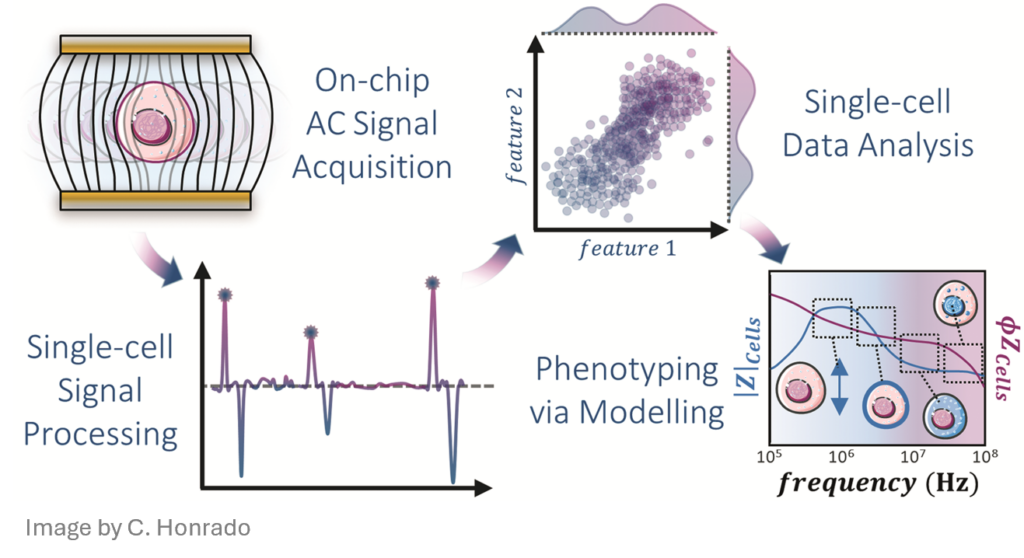
Improving the technology
Over the years, we have developed several techniques to push MIC beyond its limits:
Improving measurement accuracy by compensation of position-induced blurring (e.g., 10.1039/c6lc01516f, 10.1016/j.snb.2017.03.035, 10.1039/c6lc00339g, 10.1016/j.snb.2017.10.113) and coincidence arbitration (10.1109/TBME.2020.2995364).
Enhancing multiparametric characterization capabilities by means of innovative cytometer designs. We enabled impedance-based sensing of cell/particle trajectory (10.1007/s10404-018-2055-3, 10.1039/c9lc00071b), shape (10.1039/c4lc00221k, 10.1109/JMEMS.2014.2325979, 10.1109/JMEMS.2010.2067204), deformability (10.1109/TBME.2022.3197214, 10.1002/smll.202570038).
Addressing the longstanding high throughput vs high frequency-resolution challenge, demonstrating fast acquisition of thousands of single-cell impedance spectra at 14-frequencies with unprecedented resolution (10.1016/j.bios.2026.118757).
High-impact applications
MIC has been successfully applied in different scenarios including life-science research, diagnostics, and environmental monitoring. Contributions from our group or within joint collaborations include:
- Label-free analysis of cell viability (10.1016/j.bios.2019.111887).
- Rapid assessment of susceptibility of bacteria and erythrocytes to antimicrobial peptides (10.1021/acssensors.3c00256).
- Analysis of cells loaded in microcarriers called nanovials, for next generation single-cell analysis workflows (10.1039/d4lc00002a).
- Selective and reconfigurable single-particle manipulation by means of an innovative all-electrical platform (10.1039/d4lc00622d).
- Development of red blood cells (RBCs) as multimodal standard particles with systematically modulated subcellular electrophysiology (10.1021/acs.analchem.1c04739).
- Electro-optical analysis of single nuclei towards metaphase enrichment for karyotyping (10.1002/elps.8152) and electro-optical classification of pollen grains for environmental monitoring (10.1109/TBME.2021.3109384).
MULTIFUNCTIONAL MICROFLUIDIC PLATFORMS
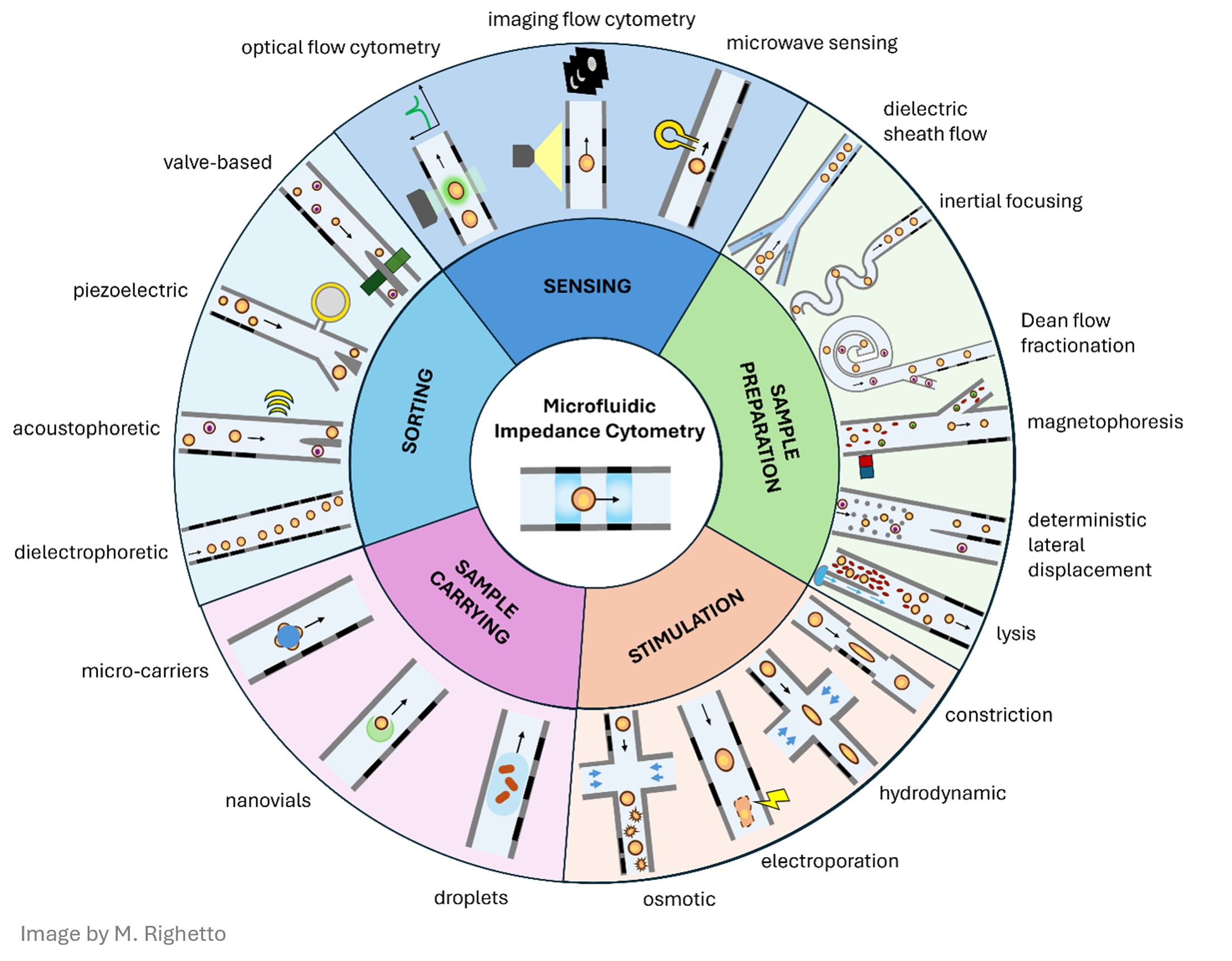
Microfluidic Impedance Cytometry (MIC) is a simple technique: it does not require labelling of the cell sample, the sensing element is just a microchannel with embedded electrodes, and the electronic acquisition system is suited for a portable implementation. Accordingly, the technique lends itself to being integrated with other microfluidic techniques, towards the development of multifunctional systems.
For an overview of the fascinating opportunities enabled by such integration, you can read our Review 10.1039/d4lc00957f, which also includes several works form our group!
WHERE AI MEETS LAB-ON-A-CHIP
The synergistic convergence of microfluidics and machine learning is expected to play a game-changing role in cell analysis and manipulation. Machine learning potentially enables the development of intelligent microfluidic platforms operated by data-driven models and characterised by increased automation. Within this framework, our group pioneered the application of machine learning to impedance cytometry (10.1007/s00216-020-02497-9). Specifically, we focused on the analysis of raw impedance signals in challenging scenarios (10.1039/d2lc00028h) and we addressed the crucial question of cross-setup generalizability within the first multi-centre study (10.1109/TBME.2026.3694594).